
carrying on: KYLE b. co.’s Critical Race Therapy / Critical Club Therapy
Sol Cabrini reflects on club aesthetics and the sonification of race in the work of 2025 CPR AiR KYLE b.co.
By Sol Cabrini
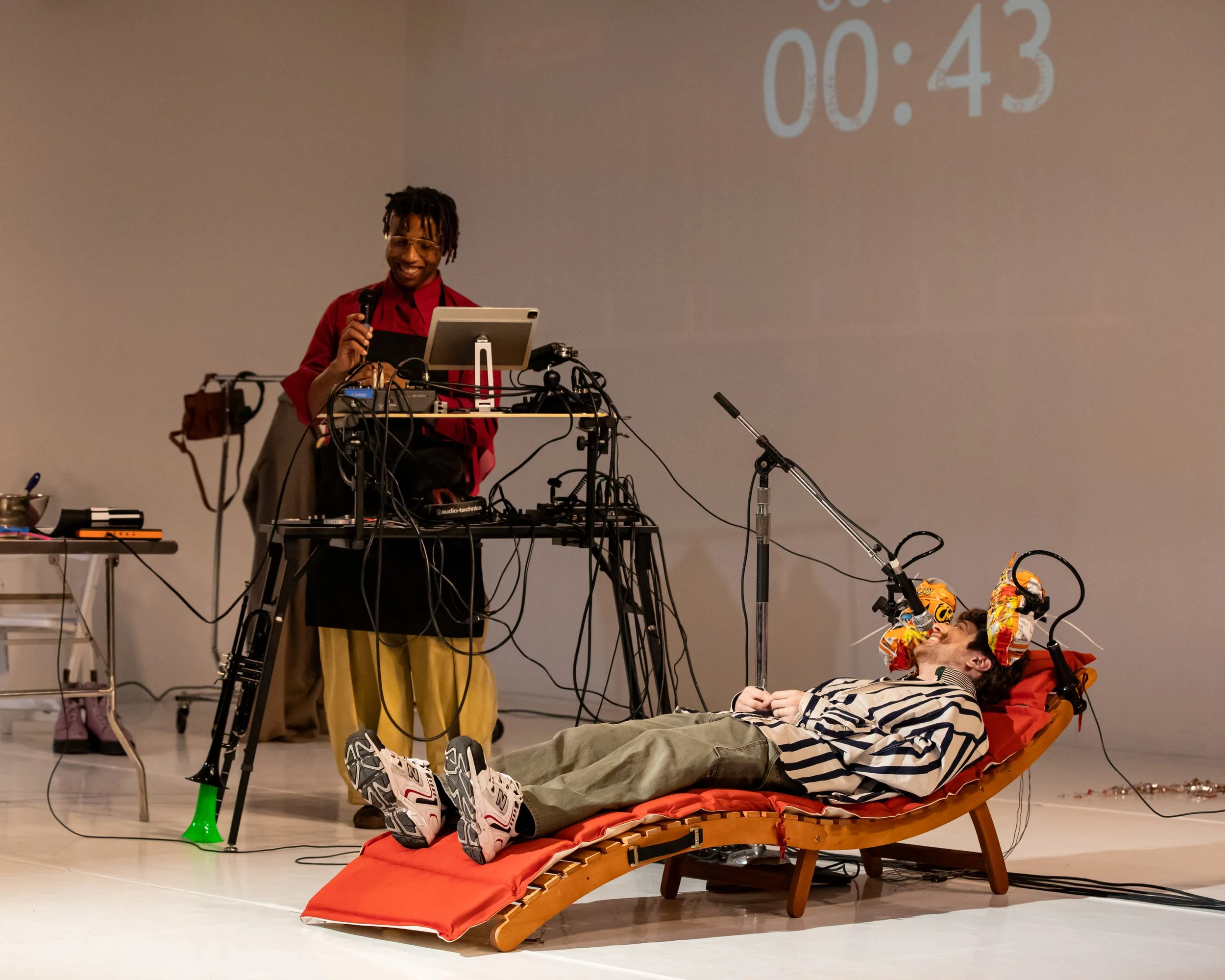
Kyle b. co.: Critical Race Therapy: Treatment 1/The Rhythm Treatment with Kyle b. co.: Orientation, presented by CPR – Center for Performance Research as part of OPEN LAB | Critical Race Therapy T1 with Kyle b. co.: Orientation on March 16, 2025. Image courtesy CPR. Photo by Elyse Mertz.
How does one write about process in performance without letting the culminating performance event become the main character? And how does one keep trust in the lead-up, the carrying-on, or even the scene before the scene—when writing about performance only after the fact of the performance event? These are the questions I considered while participating and moving with KYLE b. co.’s Critical Race Therapy and Critical Club Therapy, two distinct yet interconnected projects KYLE created while a 2025 Artist-in-Residence (AiR) at CPR – Center for Performance Research.
KYLE’s rehearsal process performs the act of being carried on. ‘Process’ for KYLE involves creative choices Black people have historically brought forth and continue to enact today in order to survive the weight of the world’s quotidian oppressions—and then some. What is carried over and inherited in KYLE’s process is not the residue of a particular genre of performance, but rather the networks of kinship and movement practices that have crossed the Atlantic and Indian oceans. KYLE’s process involves practices of nourishment and chosen family that pre-exist the general categories one assigns to performances today. This can be better understood by the fact that KYLE also has a baking practice through which they vend at different community and arts events, stemming directly from African American culinary practices. Throughout the rehearsal, KYLE, for instance, offers food to their collaborators without rushing them into the process. You could call KYLE’s process a collaborative “working with what you got” (kin)esthetic method. KYLE’s process in rehearsal, rather than “the rehearsal process,” establishes that kind of continuation between bodies, ancestors, and instruments as a fluid relay. Here, the background labor becomes primary.
In CPR’s studios, KYLE’s creative process was the atmosphere where people sat, how the microphone moved, and what happened when a voice returned after being recorded, or was encoded alongside an arpeggio. Almost every hidden mechanism is carried over to the eventual performance with intention. From here, KYLE performs and theorizes without conclusion, navigating the dynamic spaces between consent and pressure, between a question and its sampled return, and between the intimate private room and the room that opens onto others.
KYLE’s work concerns the audience with the rearrangement of faith and recognition, while double-dutching the jump ropes held between capitalism and collective gathering. Through the use of sound machines, KYLE asks how race is made audible. What is the “aftersound” of race? For instance, some of KYLE’s previous works explicitly highlighted how bells were fastened to captured slaves so that runaways and arrivals could be re-heard. One of the questions KYLE asked me to consider is “What happens when sonic presence is placed upon the body to mark it for retrieval?” KYLE’s new work still encounters that history without reducing itself to citation or the tidy transcendence of freedom.
KYLE would often sit upright in both the 1-on-1 and group therapy sessions they hosted. A participant would then lean back into the therapy-like furniture as KYLE spoke the terms of the meeting, “So welcome to Critical Race Therapy. This is a process to have a conversation around race that is not punitive or dictated or premeditated by some larger trauma, like the death of a black body or the fuckup of an institution. This is art—I’m not a therapist, and this process begins and is framed through the circuit rhythm.” Here, KYLE highlights the word “punitive” and in doing so gives their project one of its clearest orientations. At stake for KYLE is how much public speech about race sticks to a punitive aftermath, where discussions of race more or less take the form of a public scandal. KYLE moves us away from this dry talkback tone, the aftersound that arrives only when damage is already clotted into a consensus in our everyday experiences of social change. KYLE’s work enters before that. Or rather, beside its hauntings, to task us with making a social form where race can be noisy and sampled and interrupted without waiting for tragedy to authorize the contact between us.
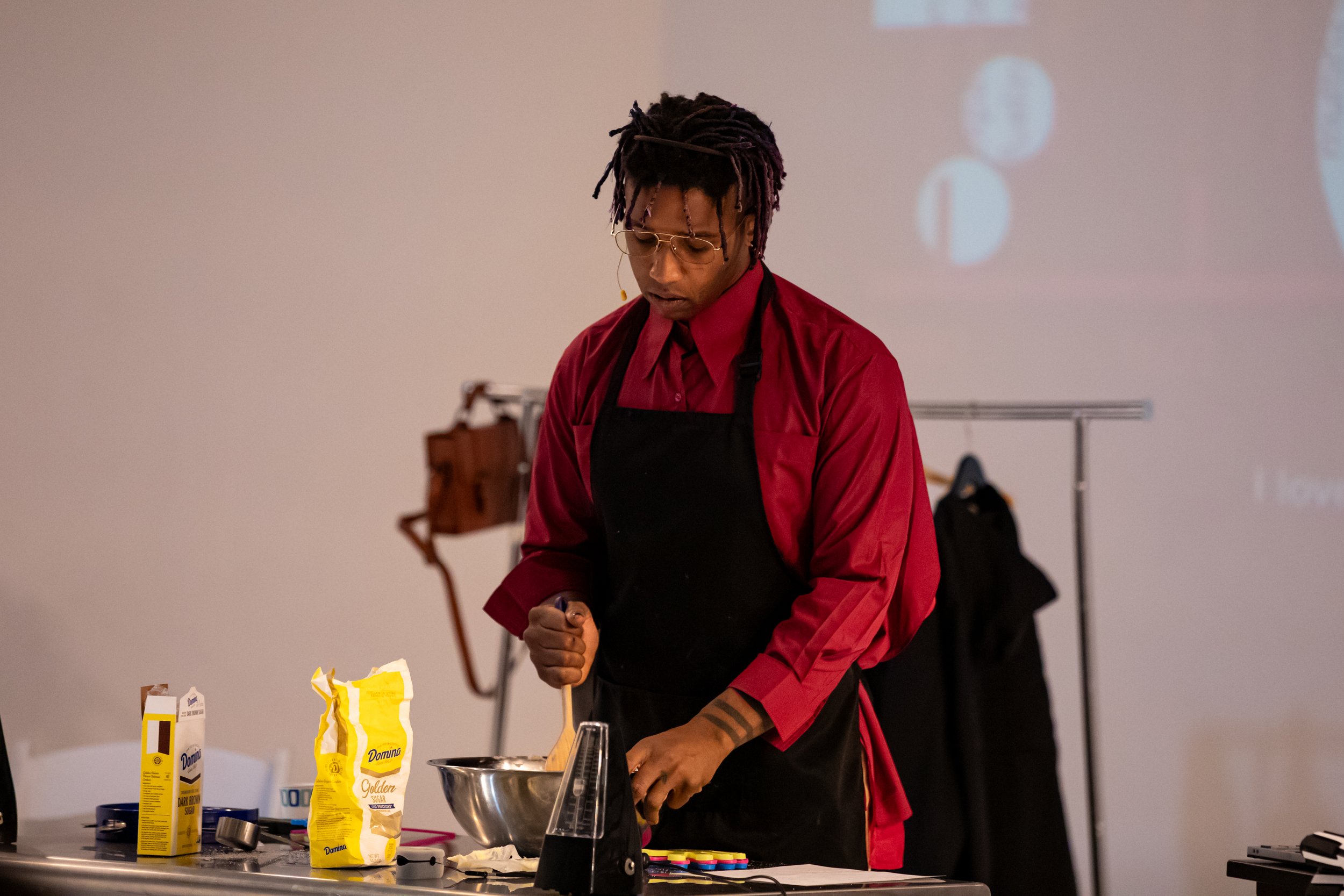
Kyle b. co.: Critical Race Therapy: Treatment 1/The Rhythm Treatment with Kyle b. co.: Orientation, presented by CPR – Center for Performance Research as part of OPEN LAB | Critical Race Therapy T1 with Kyle b. co.: Orientation on March 16, 2025. Image courtesy CPR. Photo by Elyse Mertz.
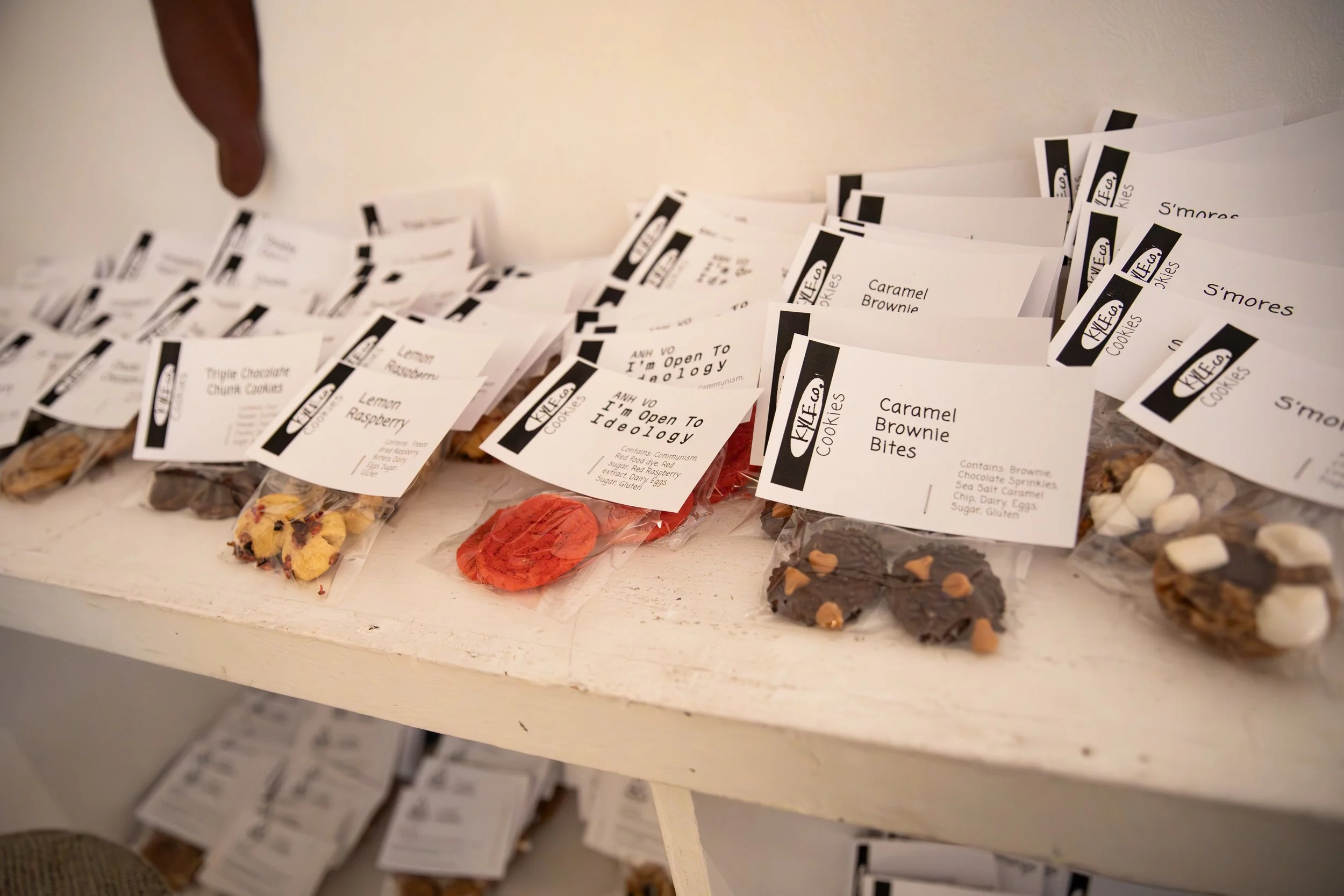
Kyle b. co.: Critical Club Therapy, presented by CPR – Center for Performance Research as part of OPEN AiR, November 13, 2025. Image courtesy CPR. Photo by Elyse Mertz.
The ethics of the project are also performed through the materials KYLE uses, like the Circuit Rhythm, which consists of an eight-track sampler and mixer. The Circuit Rhythm is made to carry only a limited set of recordings per sample pack. Three minutes of recorded sound. Up to 128 samples. This constraint per pack both carries and transmits the social problem of the recorded sessions, as well as the subsequent public staging of a musical session. A participant speaks. KYLE asks what in that speech the participant would want to offer as a sample. A decision gets made by the participant, who may also re-record themselves. Then finally the sound comes back, altered by a sequencer, by repetition, by adjacency, or by another sound from the session entering the same sonic field of contact. In that sense, the sample also stresses speech into another temporality while managing to carry relation. Nothing is truly isolated. One returns to what one has said by way of recorded loop, by way of the machine’s internal memory storage. However, even this limited storage becomes a part of KYLE’s care and way of being in process. The Circuit Rhythm is also bound up with the contract KYLE gives their participants. Instead of treating participants’ voices and experiences as raw extractable materials for artistic refinement, KYLE’s contract appears and operates as a reciprocal procedure between all parties. In one exchange, I saw a participant asking, “What would the contents be used for?” and KYLE responded, “To make a composition with you.”
In 2023, KYLE began Treatment 1: The Rhythm Treatment as one-on-one performance work at The Elizabeth Murray Artist Residency (EMAR). And in 2024, that work transformed into an installation-workshop at Grace Exhibition Space. Later installments would then carry that process into CPR. Review sessions followed the making of several projects. Participants would hear successive compositions, mic in hand, listening to fragments of their experiences move through new scenes of sound. These reviews felt close to rehearsal. This was a return to one’s own speech after it had already been shared. KYLE called them, at one point, “Demos for a participants’ race albums,” as well as “race songs.” For KYLE, these two phrases are bound up with the 1940s and popular music, where Billboard published what it called “Race Records” as a music chart that served as the predecessor to the music genres of hip-hop and R&B.
A “race song,” in KYLE’s vernacular, maneuvers one version of speech beside the sample that complicates it. This maneuvering lets race travel as a dynamic recitation, with its historical force and tension remaining variable rather than narrow. Within the earlier process, participants were given the microphone, but in the summer of 2025, KYLE elongated that relationship with Treatment 1.25: Advanced Treatment 1 at the Wassaic Project. In this version, MIDI interactions were accessed more explicitly within a wider range of instruments. These included the microKORG, the Teenage Engineering K.O. II sampler, and the Circuit Tracks groovebox. These compositional options for ‘play’ would shift the performance away from the voice alone and toward a more social field of touch and activation. Patterns developed during sessions could set off other instruments to play and amplify. Essentially, a participant’s gesture and the way they carried their body could initiate another sonic body in the room without ending at the recorded utterance emitted from the same body.
Next came Treatment 1.5, which moved further into collectivity and improvisation: group therapy as a jam band, still part of Treatment 1 and still revolving around the Circuit Rhythm. Musician and audio technician Alex Capraro joined in this group process. Here, another problem became tangible. The one-on-one room was built with privacy in mind. KYLE did not want shared moments to become exploitative or to force private racial address into public view. The group form offered another mode of circulation. Material could move outward without simply exposing the protected interior of the earlier treatment. The process expanded through learning how to accommodate alternative ways of gathering.
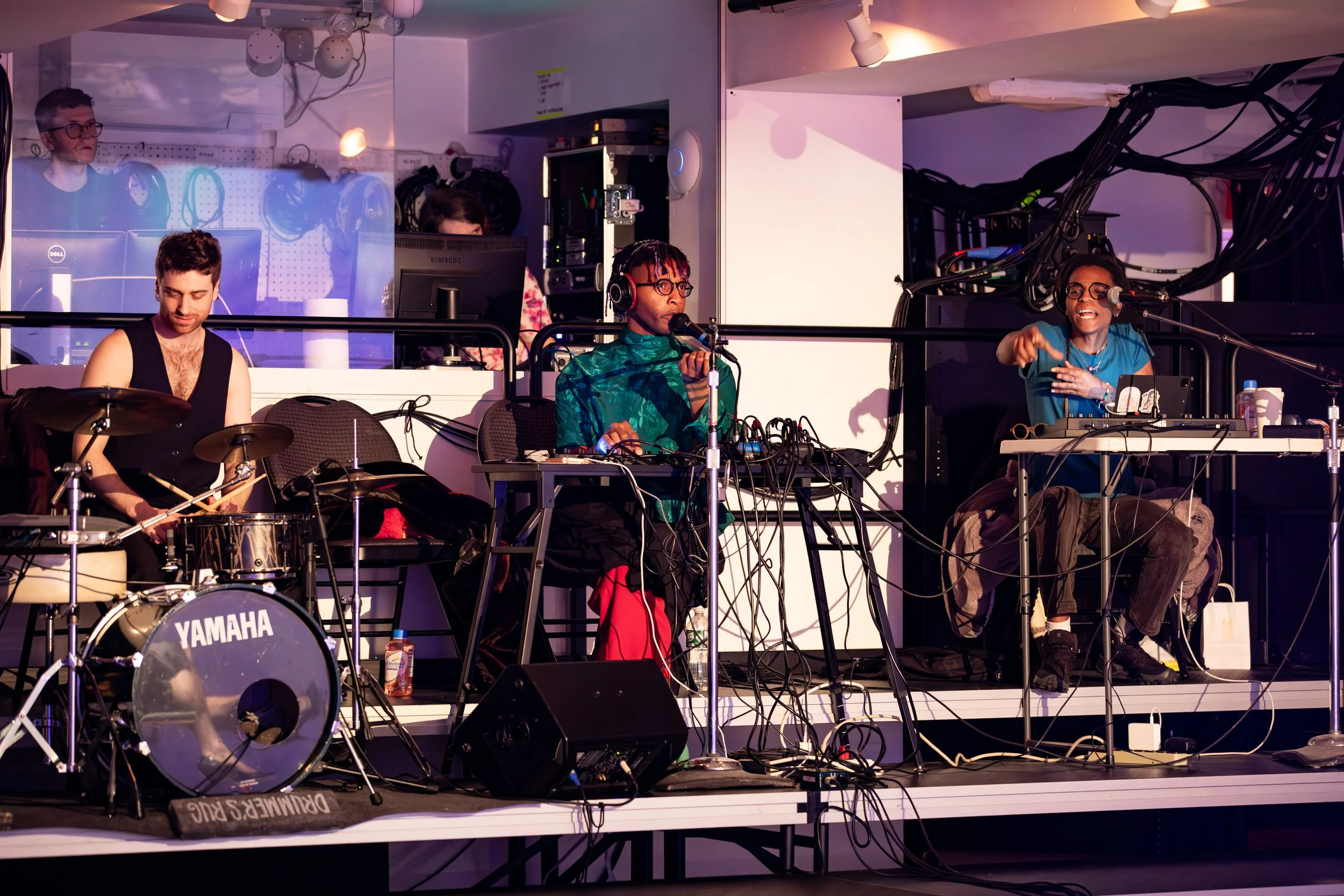
Kyle b. co.: Critical Club Therapy, presented by CPR – Center for Performance Research as part of OPEN AiR, November 13, 2025. Image courtesy CPR. Photo by Elyse Mertz.
Critical Club Therapy emerges from that widening without breaking away from Critical Race Therapy, as if the aftersound was finding architecture. There is a line to get in. There is a window, a bar, a dance floor, an entrance with stanchions, and a main room. Each of these becomes compositional and improv-based rather than merely decorative. KYLE uses the club as an aesthetic medium to redistribute the prior therapy treatments. Performance artist Buffy Sierra is the first to arrive, and she stands in the window, masked and in lingerie. The window reads several ways at once: stage, labor, document, and proposition. KYLE had workshopped Buffy’s performance beforehand. One of the scores’ earlier iterations drew from the phrase “Get Sticky With Mickey” which appears in the fictional reality game show, The Million Dollar Sticky, in the 1996 film Matilda: slime, money, grab as much as you can, game show reward, and spectacle saturated with appetite. Other materials had been in play too, including gold leaf and fisting lube, before the score changed again in process. This mutability is performed throughout. The piece keeps its revisions visible. KYLE lets the concept remain porous to what the room, the collaborators, and the accident of association do to it.
Outside, the entrance begins. KYLE’s use of stanchions brings in the velvet-rope vocabulary of sanctioned entry. Audience members line up. To get in, they are asked their Zodiac sign. Sound artist and academic Isaac Silber and I work the door as bouncers. I decide to let the Virgos wait longer than the other signs, even though my fellow bouncer, Isaac, is a Virgo. Adorned with faux fur, this is the apparatus of the club. Which is to say, it is the sorting mechanism. This is the scene where taste and admission begin to circulate collective feelings about entrances in general.
As the line outside grows, the street presses back, the architecture of clubbing turns flimsy, and fellow CPR 2025 Artist-in-Residence Crackhead Barney arrives as a force already thinking through the choreography of the public and the premise of going to see a performance. The earlier conversations KYLE had with Barney made the beginning of the night one of its most structured passages. The inside and outside directions between Barney and Buffy, the blackness Barney carries into the performance, the spotless whiteness and staged elevation of Buffy above, and the counterpoint thrown onto the other added friction. One of the thoughts circling Barney in the larger process was direct and devastating: “Why can’t I be black trash in the art world?” Barney’s question strikes at respectability as aesthetic management: Who gets admitted into readability as risk, as mess, as excess, and as institutionally tolerable deviance?
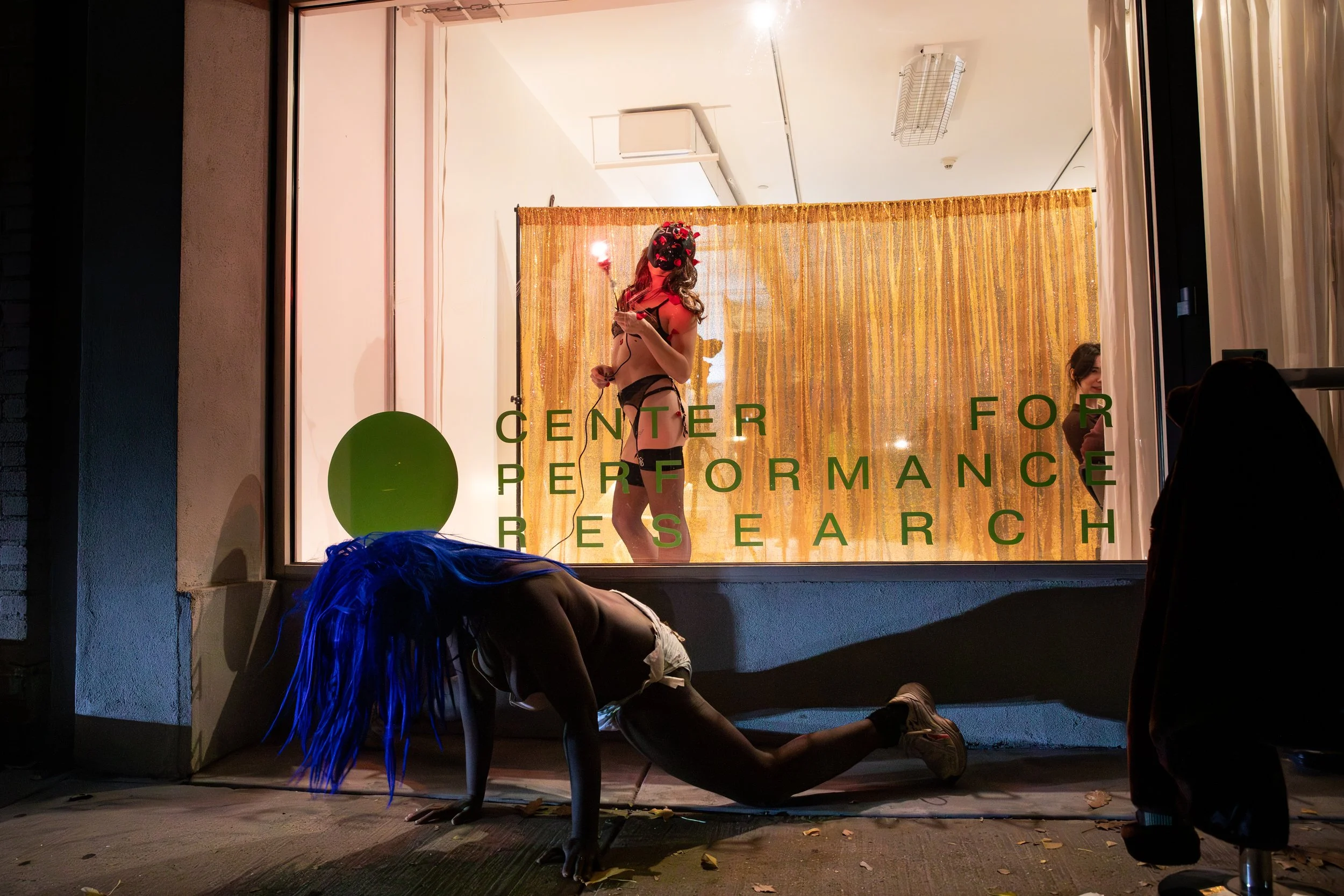
Kyle b. co.: Critical Club Therapy, presented by CPR – Center for Performance Research as part of OPEN AiR, November 13, 2025. Image courtesy CPR. Photo by Elyse Mertz.
Barney’s arrival thickens the entry to the club into a scene. She slobbers her tongue against the window where Buffy dances. The lines’ uncertainty becomes more public. Neighbors and people waiting for entry keep asking some version of the same question: is this a performance, or is this a real confrontation? Do you all need help? Do you want me to make her go away? The entrance becomes a live problem of consent, interpretation, spectacle, and de-escalation. The street touches the score, but the score absorbs the demand.
Inside, the bar opens up another aspect of the work. A third 2025 CPR AiR, Kat Sotelo, the head bartender, is given the phrase, “What do you want?” and then “Why?” repeatedly. This prompt becomes both an invitation for intimacy and for service. Kat mic’d at the bar is already part of the room’s sonic arrangement. In the bar environment, Christian D'Alessandro and Kirk Florendo are also serving drinks. A person took a shot of milk and spat it back into the glass three or four times without needing to resort to a punitive code of conduct. The bar becomes one of the clearest places where the projects’ question repeats: what do you want, and what social script rushes in when you are asked to say so aloud?
By the time the work shifts toward the main room, which is to say, the theater, the categories have already been loosened. We bouncers have become musicians. The audience enters the performance zone where they usually wouldn’t sit. The performers move into and across the areas that are typically reserved for audience seating. Isaac plays drums live. I play the synthesizer and vocalize with KYLE while sampling the group therapy sessions conducted at CPR. The background labor of the samples recharacterizes itself across the space. At this point, the show has been turned on its head.
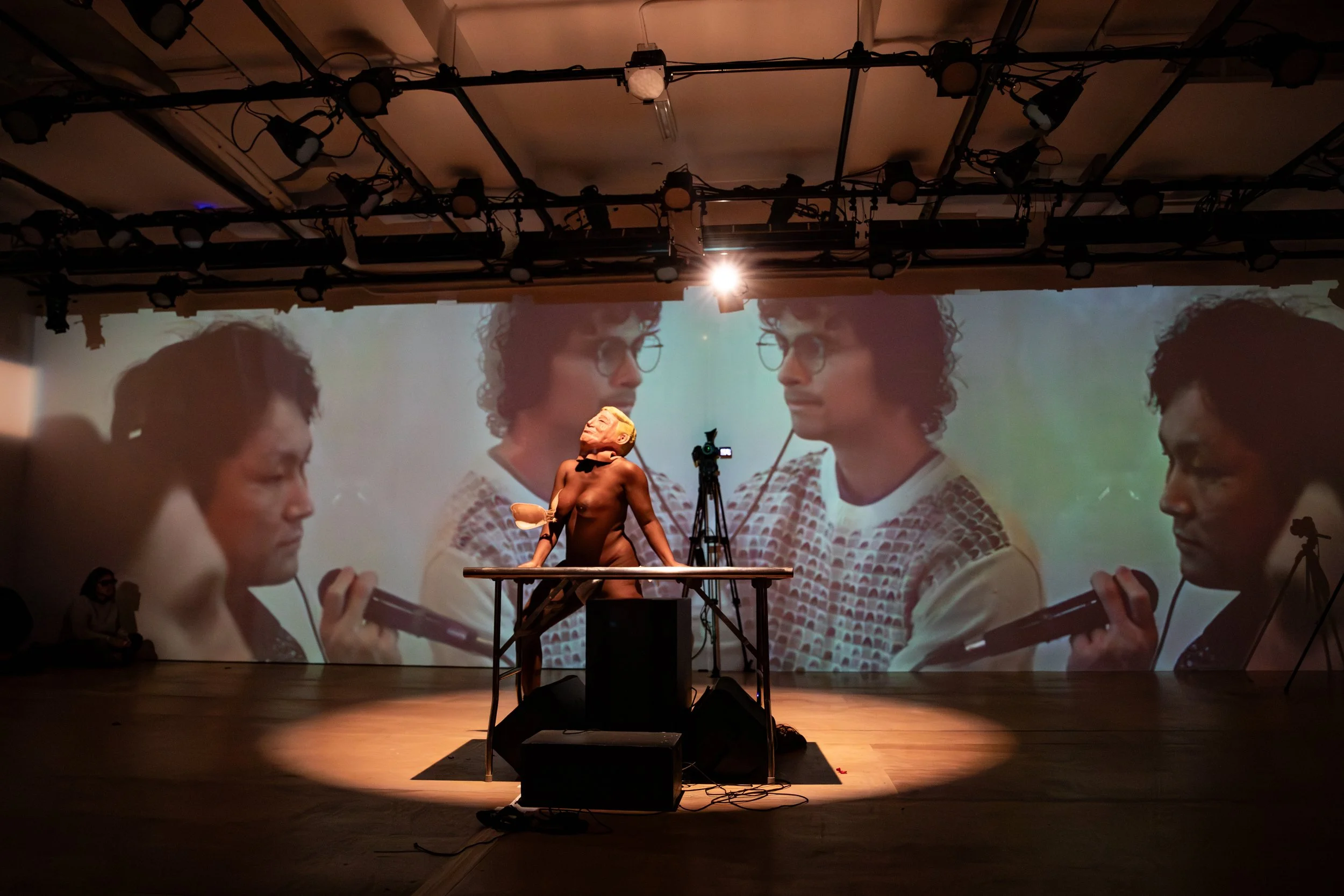
Kyle b. co.: Critical Club Therapy, presented by CPR – Center for Performance Research as part of OPEN AiR, November 13, 2025. Image courtesy CPR. Photo by Elyse Mertz.
What appeared separated now enters the same relay: bar, entrance, documentation, music, confrontation, flirtation, liveness, and institutional hosting. The room keeps revising itself. Sequences sampled from group therapy are then stretched into a jam session, an improvisation through which people move, dance, listen, and gather inside an altered hierarchy that keeps crumbling as it is built. Barney finds her way back into the building. She and Buffy move through a series of actions together. A Donald Trump mask appears. Their arms widen dramatically into contact. Light also changes color. The CPR staff, including Jaclyn Biskup, Cameron Barnett, and Kerosene Jones, with Charbel Mouchantaf documenting on video, become part of the carrying-on as well. KYLE’s work requires real-time handling. In it, no one wears the same uniform, and yet it still comprises collaborative attention. KYLE distributes presence unevenly and keeps relations moving.
Then CPR closes like any other night. Labor boundaries re-enter. Barnett informs us and the audience that we must leave. Hours are hours. The institution repossesses the room from the schedule. The closing, or closure, articulates a relation always moving with not only the contact of time but also the contracts regarding timing. The sampler’s memory is finite, just as the contract sets terms. Entryways sort and fade. The room opens as the building undergoes closure. Form, in this sense, acts as a series of constraints. It makes relations possible, difficult, and rhythmic, but also provisional.
Instead of replacing Critical Race Therapy (CRT), Critical Club Therapy (CCT) collaborated with its aftersound. The one-on-one treatment allowed for the advanced treatment to then be practiced, just as it allowed the jam band, bound up with the bar, the line, the window, the main room, and the closing announcement to perform. Each became a variation on how race might be handled outside the punitive reflex. Another way of putting it is that the attempt added much-needed pressure on how we think about an institution’s selected aftermath. In alignment with the artist’s intentions, this was exterior to the familiar demand that racial discourse be simply justified by injury to be granted public speech. As a sound-based dare and social method, KYLE’s work keeps asking another question, one that still carries over with me: what is race music without punitivity?
If process is the fact of being carried on, KYLE carried all of us for a few hours into a difficult reorientation of race as an everyday feeling. The club became a room for our redistributed experiences rather than an immediate release from gathering. And when the lights changed or when the music widened, KYLE’s process kept buzzing through the lines, in the bar, in the room, within closing time, and through the institution’s final call that even the most open clubs arrive under terms. Yet the aftersound kept moving. Something exceeded closure and disclosure all at once.
Sol Cabrini is an artist, poet, scholar, and teacher working across performance, writing, film, and sound. She is a PhD candidate in Performance Studies at New York University and the author of Tgirl.jpg (Roof Books/Segue Foundation, 2024) and Poetics of Unbeing (Duke University Press, forthcoming 2027).
Kyle b. co. is a trans-disciplinary artist, performer, educator, and baker based in Brooklyn, NY. They are a 2024-25 Franklin Furnace Fund recipient, a 2023 Smack Mellon Hot Pick, and were short-listed for the 2025 Creative Capital award in visual arts. They have received a RISCA Merit Fellowship in 3-D Arts and a Providence Arts, Culture, and Tourism Public Art Fellowship. Their work has found kinship at Hera Gallery, RISD Museum, Buoy Gallery, Zimmerli Museum of Art, Westbeth Gallery, Lucas, Lucas, and Grace Exhibition Space, among other spaces. Their practice engages with the task of mapping the present as a method of document and engagement with form. They work with materials of culture and personal history to make monuments of possibility. The matrices that hold an image may not be visible ‘til named. Their practice is one of futurity as they seek what can be sensed, not what is known. In various ways, they try to grasp at the transmission/translation of a feeling. Feeling(s) as a concept is unclear in its relationship to time. When did the feeling begin? Has the feeling ever stopped? Will you have this feeling again in the future? Their work spans both objects/installation and performance, the distinction between mediums not being that important. Their work is about feeling (&) connection(s).